What are twins, anyway?

Di-di, mono-di, mono-mono. I heard these terms for the first time from my OB as soon as I learned I was having twins. After my OB threw a bunch of twin jargon at me, I knew it was time to begin my homework. What were these other types of twins that I did not know about? Why were some types more risky to carry than others? What was I to expect during this twin pregnancy?

Fraternal twins
Identical twins: di-di and mo-di
Identical twins: mo-mo
Identifying twin type in early pregnancy

Fraternal twins

Broadly speaking, there are two types of twins: fraternal and identical. A mother can release two eggs simultaneously, and each one can be fertilized and implant itself into the endometrium of her uterus. Because these twins arise from two separately fertilized eggs, they are termed dizygotic (di-two, zygote=fertilized egg). They grow like any other embryo (Fig. 1). After about four days of cell division, each fertilized egg, or zygote, forms a hollow cavity and is called a blastocyst (Fig. 1A). The blastocyst contains an outer sphere of cells that will play a role in implantation, and an inner mass of cells that will develop into the embryo, its nutritive yolk sac, and its protective amnion. A week after fertilization, the zygote will have completely burrowed into the mother’s endometrium (Fig. 1B). In the endometrium, cells from the outer cell mass proliferate and will contribute to the chorionic membrane and placenta. The inner cell mass begins to differentiate into a dorsal mass and a ventral mass. Cavities form in the dorsal mass and the ventral mass. The ventral mass will develop into the yolk, which nourishes the embryo until the placenta is developed. The dorsal mass forms a cavity called the amniotic cavity, which will grow with the embryo and fill with fluid. The cells of the dorsal mass contacting the chorion will develop as the amniotic membrane while the cells contacting the yolk will develop as the embryo. Because two fertilized eggs have each buried themselves into the mother’s uterus, each baby develops its own chorion/placenta, and its own amnion (Fig. 2). Therefore, these twins are dichorionic-diamniotic or di-di. Dizygotic twins are as genetically similar to one another as any other sibling pair, and are known more colloquially as fraternal twins.
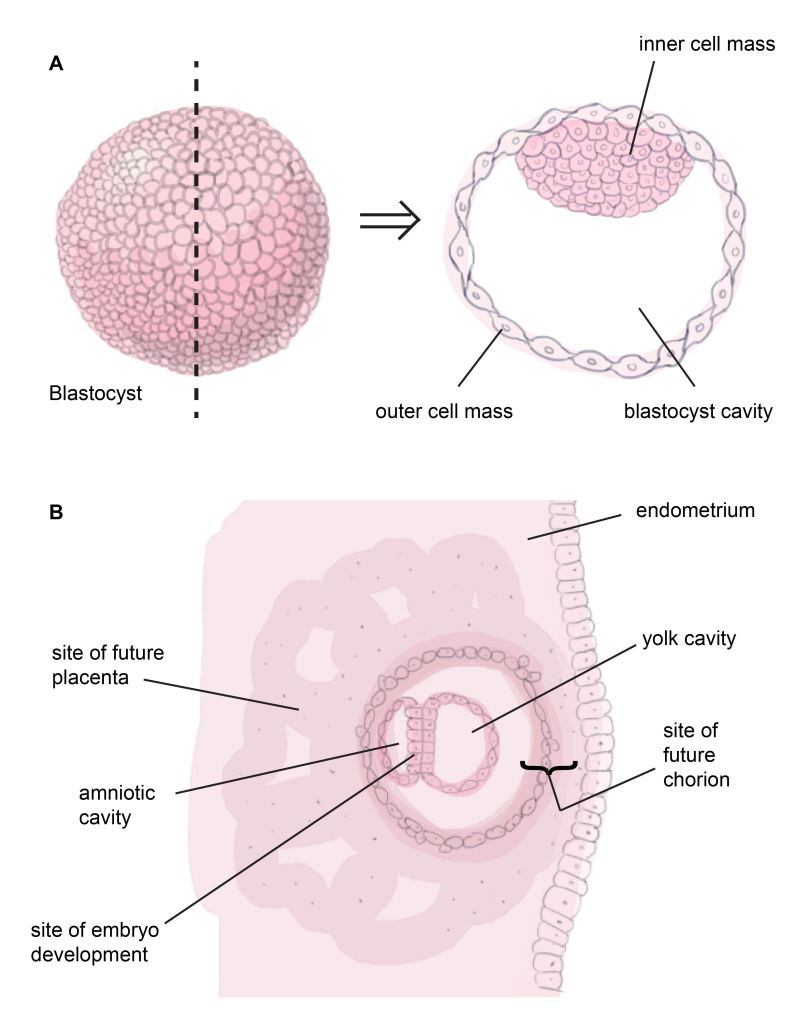
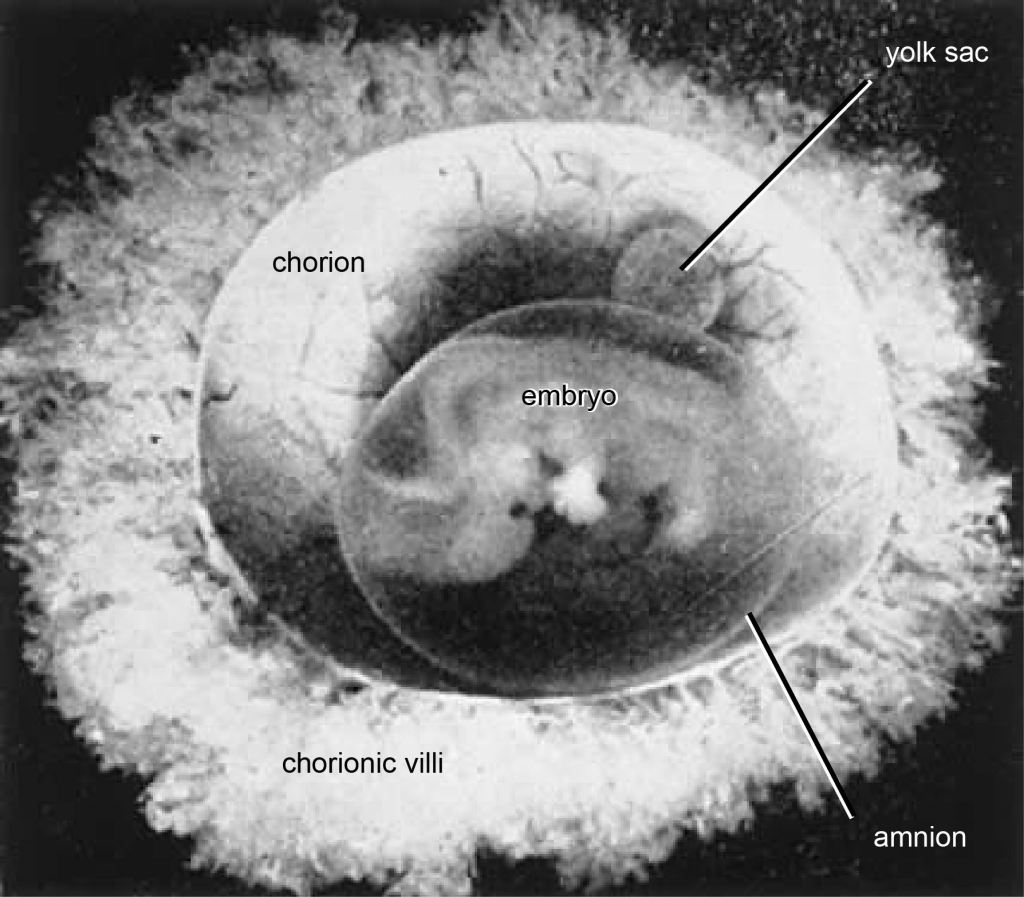
Figure 1. Anatomy of a zygote. (A) Cross section through blastocyst, a zygote that has formed a cavity surrounded by an outer cell mass and an inner cell mass. (B) Blastocyst implanted into the endometrium, or deciduous portion of uterus.
Figure 2. 40 day-old human embryo. In a di-di pregnancy, each embryo develops as a singleton embryo would. Here, the embryo is visible floating in its amniotic sac. The yolk sac is in the extracoelomic space within the chorion. The fuzzy-looking chorionic villi surround the entire surface of the chorion this early in development. They comprise the fetal portion of the placenta. Image credit: Ahokas and McKinney, 2008)

Identical twins: di-di and mo-di

The second type of twin, identical twins, is where twin classification becomes a little more complicated. They are termed identical because their DNA is nearly 100% identical. This happens when a mother releases one egg, as she ought to, but then after fertilization that egg throws a curve ball at her and splits itself into two zygotes! Because these two zygotes began as one, identical twins are also called monozygotic (mono-one, zygote=fertilized egg). Why would a zygote split? The cause is not yet well understood, but what is known is that for a brief moment during cell division, the tight connections between cells of the zygote lose integrity and the mass of future embryonic cells splits apart. If the split occurred very early, within the first three days after fertilization while the zygote is still aiming for the perfect real estate in the mother’s uterus, they will each develop their own chorion, placenta, and amnion (Fig. 3A). They will become, you guessed it, di-di twins. Just like fraternal twins! Only, remember, these twins have 100% of each other’s DNA in common. If this zygote splits into two after it has buried itself into the endometrium and developed its chorion, but before it has developed its amnion, then each embryo will share the chorion and placenta, but dwell in their own amniotic cavity. This schism would have to occur between 4 and 7 days after fertilization (Fig. 3B) and these twins would be referred to as mono-di or mo-di.

Figure 3. Timeline of a zygote. (A) Cell division, or mitosis, of the fertilized egg occurs approximately 30 hours after fertilization. A complete division of this zygote will result in two identical dichorionic-diamniotic twins. (B) Between four and seven days of cell division, a zygote is in the body of the uterus and may begin implanting into the endometrium. This is when the future placenta begins to develop. If the zygote splits at this point, the resulting twins will share a placenta but each embryo will develop its own amnion, classifying them as monochorionic-diamniotic twins. (C) After 7 days of mitosis, the zygote has established its chorion and begun to develop its amniotic cavity and membrane. A split in the embryonic mass (see Fig. 1) at this point will result in identical twins who share a placenta and an amniotic sac, classifying them as monochorionic-monoamniotic.

Identical twins: mo-mo

Identical twins are pretty rare. Mo-di identical twins are actually more common than di-di identicals, despite the fact that fraternal twins (which are always di-di) are the most common type of twin overall. But the most uncommon twins of all, the rarest of the rare, are the monochorionic-monoamniotic twins, a.k.a. monoamniotic, mono-mono, and momos. They occur in 1% of all twin pregnancies. That’s about 1 in 60,000 pregnancies! These twins are susceptible to a host of problems including developmental anomalies and cord compression, along with other problems that come with having mo-di twins such as Twin-to-Twin Transfusion syndrome or TTTS.

Momo twins result from the zygote splitting after the 8th day post-fertilization (Fig. 3C). The unfortunate circumstance of splitting so late is that one of the zygotes may not acquire the proper unspecialized cells it needs to completely grow itself. Incompletely developed fetuses or midline developmental defects are more common in monoamniotic pregnancies. One could imagine that the variety of developmental issues common in momos lies on a continuum based on the timing of separation. A very late split of the zygote will result in conjoined twins, who may share a heart or part of the GI system. Sadly, such twins seldom survive long after birth, if they make it that far.

Identifying my twin type in the early first trimester

Of course as soon as I learned I was having twins, I was aching to know which type I was carrying. And like any other pregnant woman, I wanted to know their biological sex. Statistically, I was going to have boy-girl fraternal twins. Fraternal twins are 66% more common than identical twins. Further, my demographic would suggest they are likely fraternal since fraternal twins more commonly occur in non-Hispanic whites.

However, unlike identical twins, fraternal twins typically run in families. Fraternal twins do not run in my family. It is of no consequence to me if they run in my husband’s family since he does not affect how many eggs I release (sorry hubs, I know you like to imagine your extreme manliness can cause twins). But for the record they do not run in his family either. Therefore, my twins were a freak occurrence and quite possibly identical. Further, my ultrasounds did not look like early ultrasounds of dichorionic twins (Fig. 4A). Even though the membranes are thin at eight weeks, there is often a characteristic mountain peak or lambda shape visible where the placentae abut one another (Fig. 4B). On mine, there was no peak (Fig. 4D). Sharing a placenta would have to mean my twins were identical. So then I had a 50:50 chance of carrying boys or girls. Unless they were monoamniotic; then my chances of having two girls would double since twice the number of momos are female than male. But monoamniotic is not very likely. Could my babies be one in 60,000? No way.

Oi. I couldn’t wait for the 20-week ultrasound to answer these questions. I needed a blood test.
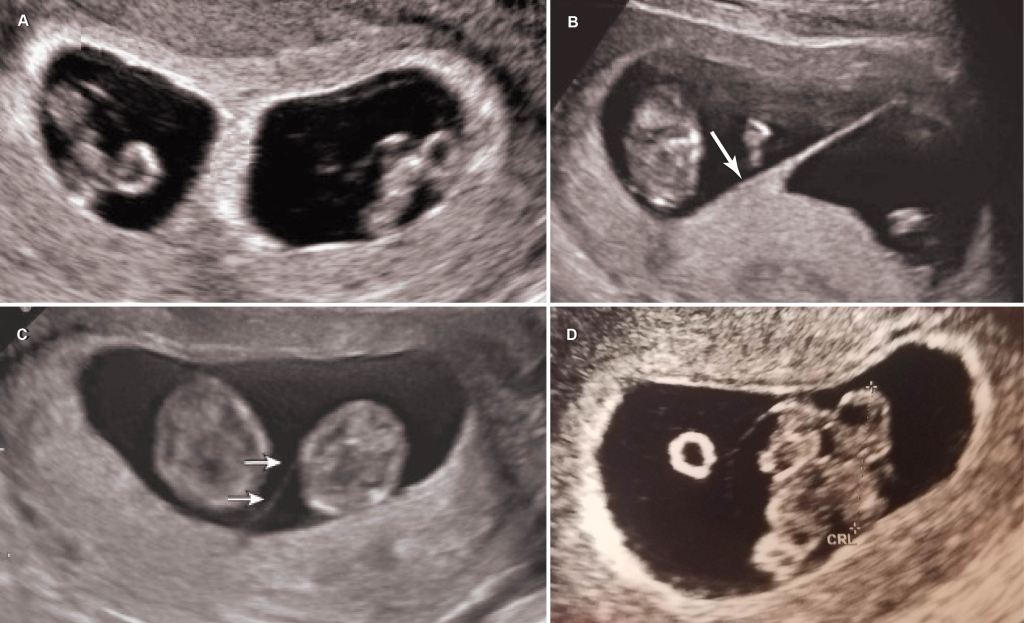
Figure 4. First trimester ultrasounds (US) of twins. (A) Early first trimester US of di-di twins, well separated in their own gestational sacs with two yolk sacs visible. (B) Late first trimester US of di-di twins when characteristic lambda sign (arrow) is visible. Lambda formed by thick, four-layer membrane at its placental insertion. (C) Late first trimester US of mono-di identical twins with diagnostic T-sign (arrows), formed by thin, two-layer intervening membrane attaching to shared placenta. (D) 8w4d US of my monoamniotic twins. At this stage, diagnosis of amnionicity is tentative. But note the absence of a thick dividing membrane (putatively ruling out dichorionicity) and single yolk sac (indirect indicator of monoamnionicity, Bromley and Benacerrof, 1995). Image credit: A-C from Fuchs and D’Alton, 2018

References

Ahokas, R.A. and McKinney, E.T. 2008. Development and physiology of the placenta and membranes. The Global Library of Women’s Medicine. ISSN: 1756-2228) 2008; DOI 10.3843/GLOWM.10101

Bromley, B. and Benecerrof, B. 1995. Using the number of yolk sacs to determine amnionicity in early first trimester monochorionic twins. Journal of Ultrasound in Medicine 14: 415-419.

Fuchs, K.M. and D’Alton, M.E. 2018. Monochorionic monoamniotic twin gestations In J.A. Copel, M.E. D’Alton, H. Feltovich, E. Gratacós, D. Krakow, A.O. Odibo, L.D. Platt, and B. Tutschek (Eds.), Obstetric Imaging: Fetal Diagnosis and Care (pp. 642-645.e1). Elsevier, Inc. Retrieved from https://doi.org/10.1016/B978-0-323-44548-1.00159-5

———————– 2018. Monochorionic diamniotic twin gestations In J.A. Copel, M.E. D’Alton, H. Feltovich, E. Gratacós, D. Krakow, A.O. Odibo, L.D. Platt, and B. Tutschek (Eds.), Obstetric Imaging: Fetal Diagnosis and Care (pp. 645-648.e1). Elsevier, Inc. Retrieved from https://doi.org/10.1016/B978-0-323-44548-1.00160-1

———————– 2018. Monochorionic monoamniotic twin gestations In J.A. Copel, M.E. D’Alton, H. Feltovich, E. Gratacós, D. Krakow, A.O. Odibo, L.D. Platt, and B. Tutschek (Eds.), Obstetric Imaging: Fetal Diagnosis and Care (pp. 648-650.e1). Elsevier, Inc. Retrieved from https://doi.org/10.1016/B978-0-323-44548-1.00161-3

The Journey Begins

You have twins! Or: Is more really merrier?

The discovery
Early symptoms of a twin pregnancy
My momo journey

The discovery

After multiple losses and seven months of actively trying to conceive a sibling for my daughter, I was pretty anxious about my first OB appointment proceeding my latest positive pregnancy test. Six months earlier, I was in the same clinic anticipating my first glimpse of the 9.5 week old embryo inside of me. When my physician fired up the ultrasound, I saw a tiny bean on the screen. It looked far tinier than I remembered my daughter looking when she was an 8 week embryo. Then my OB measured the heartbeat. It was slow, and the embryo measured three weeks behind. My baby was dying. Though I knew that those first few weeks of pregnancy are the most tenuous, the memory of the pain I endured from my last chemical pregnancy took over me and I nearly fainted in front of my OB and husband. Now I was back in the same room, this time without my husband, about to confirm a pregnancy I was hoping for over two years prior.

The profile of an embryo flashed on the monitor. It looked much larger than the last poor embryo I lost. That was a comforting sight! “Looks good,” my physician assured me as she continued to survey my pelvic cavity with the ultrasound wand. The baby slipped from view but then suddenly re-emerged, this time in a frontal view. I was very confused as to how I could see a baby in profile and then almost instantly view it head on. “I don’t understand how to read ultrasounds,” I thought to myself. But my OB grew suspicious. She was silent for what felt like forever, studying the ultrasound monitor very intently. I began to feel slightly tense.

Suddenly, two embryos appeared on the screen (Fig. 1). She found what she was looking for.

“F**************k,” I groaned under my breath. I’m not usually one to swear.

Figure 1. Two embryos in a yin-yang orientation. The left twin (to the right in the image) is facing the viewer and its head is up. The right twin (to the left in the image) is in profile and its head is down. The gestational age of the embryos is 8 weeks and 4 days.

I began to panic. I couldn’t believe this was real. Twins don’t run in my family, how could this happen to me? I have read some women’s reactions to the news that they are bearing twins. Some women have wanted twins all their life and are elated when they receive the news. Clearly, from my reaction, I was not one of those women. Some people look at parents juggling twin babies and feel pity for them, unable to fathom the exorbitant amount of work it must take to raise more than one child simultaneously. This was not crossing my mind, either. I knew very little about twins, but what I did know at the time of the diagnosis was that carrying twins comes with a host of difficulties and immediately launches my pregnancy into high-risk. After suffering through losses, and waiting years to make another baby, I have made two babies with a tenuous outcome. Instead of dealing with an early loss of one baby, I could face a late loss of two babies. How could I possibly endure it?

“I’ve heard of cases with twins where one dies very early and gets absorbed by the other. Is that still a possibility?” I foolishly asked my OB in hope that my situation might turn into a normal singleton pregnancy.

“Not at this point,” she assured me. The embryos were too far along and looked too healthy, which of course was actually a good thing. She continued, “Now we’ll need to figure out if they’re di-di, mono-di, or mono-mono.” These words were completely foreign to me. I knew twins came in two flavors: fraternal (dizygotic) and identical (monozygotic). “If they are mono-mono then we have a problem but those are extremely rare. These are likely mono-di or di-di. Di-di is the safest, but we can work with mono-di. Right now the membranes are too thin to tell what type of twin you have, but we’ll be able to tell over time when the membranes get thicker.”

My head was spinning. I was sent home with a packet of standard pregnancy pamphlets, plus a giant list of supplements to take especially for women expecting twins.

My husband could not attend the appointment because he had a class to teach that morning. I got out of the appointment 15 minutes before his class would begin so I gave him a call.

“I have good news and bad news,” I told him. “Good news is the baby looks healthy! Bad news, if you want to call it that, is there are actually two babies. And with that, I’m going to let you go so you can teach your class.” My husband began laughing. I could tell he was smiling ear to ear. I wasn’t sure how he would handle the news but I wasn’t expecting him to be so happy about it. I’ve got to say that his enthusiasm did ease my mind a bit, and for the first time since the initial discovery, I began to feel a little excited too.

Early symptoms of a twin pregnancy

After my twin diagnosis, a lot of my early pregnancy symptoms began to make sense. My symptoms had surprised me for being stronger than I remember with my first, singleton pregnancy. In retrospect, five early symptoms were possibly indicative of twins.

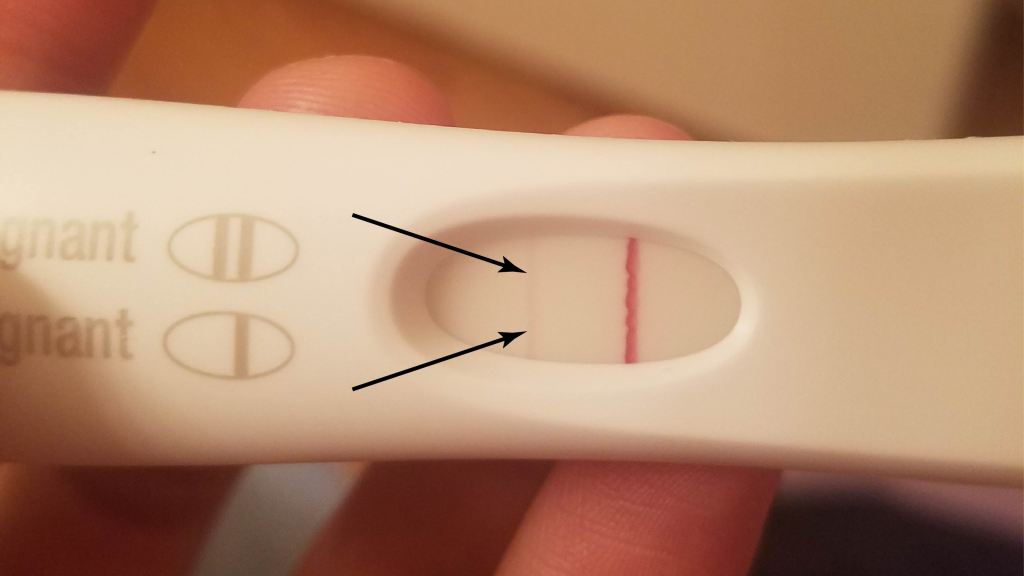
1. A dark line on my pregnancy test. I could not wait to find out if I was having another baby so I did the one thing I told myself not to do: I peed on the stick early. Only 10 days after ovulation. Yes I was using a first response early detection test, but results are not guaranteed so early. Yet there it was, an unambiguous positive staring back at me (Fig. 2). I texted the pic to a friend. “Wow! That looks dark for only 10 days,” was her response. In hindsight, yes, I suppose it was.

Figure 2. Home pregnancy test, early response test, taken just 10 days past ovulation. Arrows indicate test line. The line looked darker in person, I swear! 😊

2. Extreme fatigue. How extreme? Here’s an example: My daughter (Fig. 3) was going through her “tattoo artist” phase. She would regularly give me a tattoo at 7:30 or 8 p.m. Using my expensive gel pens, she would scribble all over my hand. The metal tips of the pens would dig into my flesh; it’s a wonder I didn’t bleed. She would merrily inquire, “Does that tickle mommy?” But I couldn’t answer her. I was already passed out on the bed…at 7:30…while pen tips scraped off my skin.

Figure 3. Beatrix, the Elder. Do not let her innocent face fool you. She was more than willing to take advantage of my condition to inflict her masochistic urges upon me.

3. Insatiable hunger. Anyone who knows me knows I love food. But my hunger in early pregnancy felt pathological. Every minute of the day, I was thinking about food. I was fantasizing about my next meal while I was still eating my current meal! And when I was so full I wanted to vomit, I still thought about what I could eat next. Sometimes I was afraid of my own appetite.

4. Intense nausea and vomiting. Speaking of vomiting. Yeah. This symptom is a little strange for me. Some women experience debilitating nausea during their first trimester. I’m not one of those women. I felt nauseous when I was expecting my daughter, but it was on and off and quite manageable. I may have vomited once. And with this pregnancy, I told my husband repeatedly that I felt less nauseous than with my first. My vomiting record says otherwise. Though I didn’t feel an omnipresent nausea, I vomited almost daily (sometimes twice daily) when brushing my teeth. I am in my second trimester and I still vomit. Further, buffalo plaid was coming into season at the height of my morning sickness, and I found that just looking at someone wearing the red-and-black pattern would start me dry heaving. Maybe I was more nauseous than I wanted to admit.

5. Child psychic abilities. Okay, this one has no scientific merit. But sometimes people swear their child knows when they are pregnant, or knows the gender before the parents know. Once my husband and I knew we were expecting, we asked our daughter if she was excited for a baby brother or sister. She told us she was very excited for her baby brother AND sister. “You’re only having one,” we warned her. “No, we’re having two,” she would laugh in response. Really, she was warning us.

My momo journey

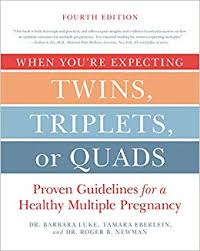
After the twin diagnosis, my pregnancy experience would be vastly different from my previous singleton pregnancy. Because my pregnancy was now classified as high-risk, I would have to visit a maternal fetal medicine (MFM) specialist at the perinatology clinic every two weeks. The upside would be plenty of ultrasounds. As long as the lower of the two twins was head-down by 24 or so weeks, I could anticipate a vaginal delivery as late as 37 weeks. The book, When You’re Expecting Twins, Triplets, or Quads, by Dr. Barbara Luke et al. (Fig. 4) quickly assured me that a twin pregnancy did not have to result in underweight, fatally premature, or developmentally malformed offspring. I highly recommend the book to anyone expecting multiples. Despite my optimism, a later surprise diagnosis would launch my pregnancy into extreme lows but also some highs, and I would have a lot more to learn about what it takes to safely carry twins. I don’t know where my journey through twin pregnancy will take me. But I hope by the end I will be taking home two healthy momo twins. Please join me on my momo journey!

Figure 4. “When You’re Expecting Twins, Triplets, or Quads,” by Dr. Barbara Luke et al. A must-read for anyone carrying more than one fetus.

Please feel free to share your experience of when you learned you were expecting multiples in the comments below!